

June 16, 2025
I was going to submit an article to a popular online publication explaining what I discovered several months ago while I was doing personal research into the orbital period of planet Sedna, but for this topic specifically, I decided not to.
Initially, I revealed everything right here on Nooz Buffet, so I decided it would be best to continue in that direction.
What is this topic so hot?
Well, since planet Sedna was discovered in, I think 2003, we’ve been told by authorities and experts in the field that Sedna’s orbital period was 11,400 years. I kid you not, I’m pretty sure Sedna was discovered on the date that I graduated college, August 23, 2003!
Anyway, for the last twenty-two years, an 11,400-year orbital period was gospel. Even after I reported my findings two months ago, people still continued posting new videos about Planet Sedna while boasting about that extremely long orbital period of hers that takes her way out to the Oort Cloud.
It’s like one person said 11,400 years, and everyone else just repeated it for twenty-two years. Kind of robotic and not really original if you ask me.
Then, two months ago, I decided to do favor for my Nooz Buffet followers. I was going to give a free interpretation of planet Sedna in the natal charts of the first twenty people who responded to me by email. Honestly, it was only because of this that I decided to begin my research. I thought I should familiarize myself with as much knowledge as possible so I would be prepared for anything that might arise during the interpretations.
I decided to track planet Sedna around the zodiac wheel because I wanted to see how long she spent in each sign. I was both fascinated and intrigued, and at the time, I was still conducting my research on the basis that her orbital period was 11,400 years. As a really slow-moving planet, I was expecting to see something crazy like almost 1,000 years per sign.
When I was born, Senda was on the 5th degree of Taurus, so I started there. Nice and simple.
When did Senda enter Taurus, and when was she due to leave?
Well, Sedna was on the Zero degree of Taurus in 1966 on May 12th, and that was the beginning of a 58-year transit.
I moved forward to Gemini and Cancer and did the same thing. Immediately, I knew something wasn’t adding up. 58 years in Taurus, 43 years in Gemini, and 41 years in Cancer?
That wasn’t a very long time for a planet that had an 11,400-year orbital period.
I continued to press forward and something unexpected happened.
Using astro.com, I was able to track Sedna into the future to August 23, 2998. At 7:05 p.m. on 8/23/2998, planet Sedna was seen going retrograde on 947 degrees of Sagittarius in the Tenth House.
At 7:06 p.m., Sedna was gone and no longer available!
At that point, I decided to work backwards from May 12, 1966, and this is what I discovered.
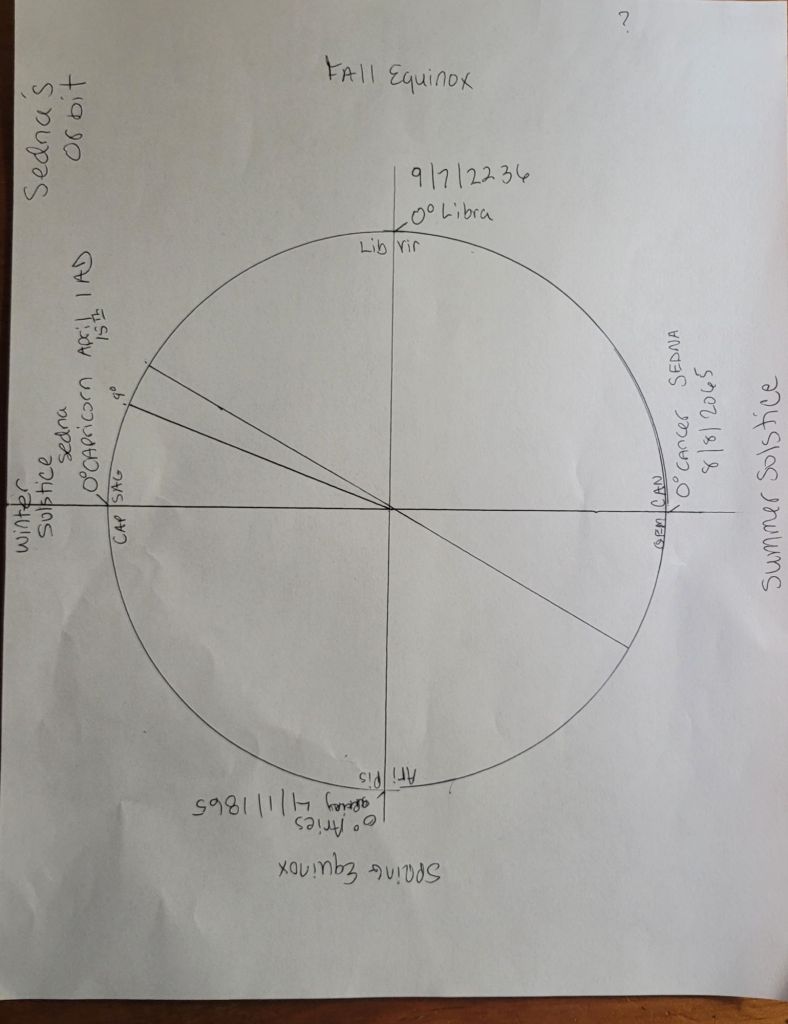
Planet Sedna was on the Zero degree of Capricorn (Winter Solstice Point) on April 15 in the year 1 AD, on the Zero degree of Aries (Spring Equinox Point) on April 1, 1865, on the Zero degree of Cancer (Summer Solstice Point) on August 8, 2065, and on the Zero degree of Libra (Fall Equinox Point) on September 7, 2236.
Like I said, I was able to track her to the 9th degree of Sagittarius.
So, we’re basically talking about 2,998 years from the Zero degree of Capricorn to the 9th degree of Sagittarius.
11,400 – 2998 = 8,402 years short!
However, the only question left was the last twenty degrees of Sagittarius that Sedna mysteriously disappeared before.
Are we to believe that it takes Sedna 8,402 years to cover the last twenty degrees of Sagittarius?
Or does it seem more sensible to believe that it would take Senda 602 years to complete the last twenty degrees, which would mean that Sedna possesses the almighty-holy-grail of all orbital periods, 3,600 years?
I’m going with the latter. And that would mean that when Sedna reaches her closest approach to the sun, in roughly 2076, she’ll be in the astrological sign, Cancer, which is in opposition to where she began, and she will then become..
NIBIRU!
 Nooz Buffet